
Karpenter + EKS: ghost Target Groups and a zero-downtime fix
Field note on a common EKS pattern: manual ALBs, static node IPs in Target Groups, and Karpenter. How TargetGroupBinding (AWS Load Balancer Controller) restores stability without rebuilding API Gateway.
By the QSTools team — composite field notes from production EKS work. Details generalized on purpose.
In multi-account AWS setups with EKS + Karpenter, a recurring failure mode shows up after a hasty EC2→EKS move: every node recycle drops traffic. Karpenter is rarely the villain. The data path still pins static node IPs inside classic Target Groups behind a legacy ALB.
At a glance
| Signal | Root cause | Fix |
|---|---|---|
| Outages on scale / deploy | Target Groups with static node IPs | TargetGroupBinding + targetType: ip |
| Support ticket storms | API Gateway → legacy ALB without LBC | Keep ALB/Gateway; automate the TG |
| Fear of touching prod | No maintenance window | Phased cutover, near-zero downtime |
| Remaining debt | EKS nodes on public subnets | Safer once targets no longer depend on node IPs |
The pattern: growth faster than network governance
Teams often start well—account segregation, Terraform, standardized EKS templates—then product velocity outruns the exposure layer:
- Services still fronted by manual ALBs (originally built for EC2).
- EKS migration without modernizing that ALB/TG model.
- API Gateway (VPC Link) still glued to those ALBs.
- Target Groups with hardcoded node IPs.
- Karpenter arrives for cost/scale… and recycles those nodes.
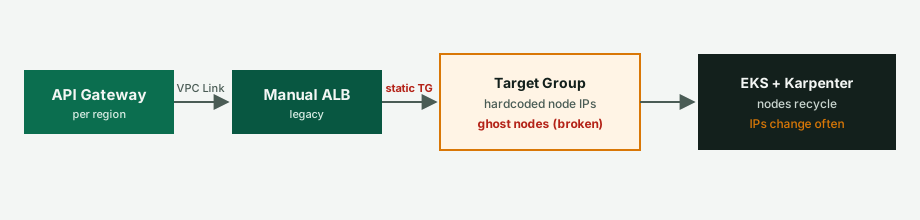
Day-to-day: every deploy or scale event means lost targets (“ghost nodes”). Remediation usually has a hard constraint: no downtime on critical paths.
Diagnosis in one line
Karpenter did its job. The Target Group kept pointing at IPs that no longer existed.
Three-phase fix (zero downtime as a hard constraint)
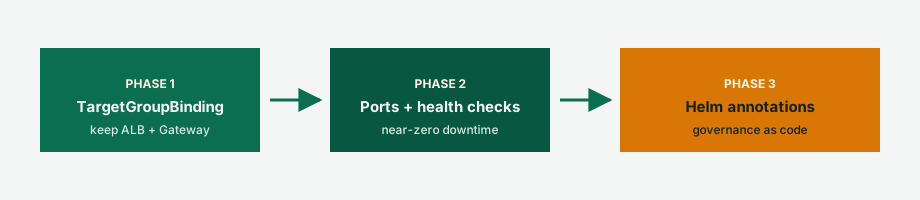
Phase 1 — Decouple with TargetGroupBinding
Use the TargetGroupBinding CRD from the AWS Load Balancer Controller (LBC) so the controller manages the existing Target Group—without recreating ALBs or rewriting API Gateway routes.
apiVersion: elbv2.k8s.aws/v1beta1
kind: TargetGroupBinding
metadata:
  name: tgb-critical-service
  namespace: production
spec:
  serviceRef:
    name: svc-critical-service
    port: 8080
  targetGroupARN: arn:aws:elasticloadbalancing:region:123456789012:targetgroup/tg-critical/abcdef123456
  targetType: ip
(Example ARN — use your real Target Group in production.)
Phase 2 — Ports and health checks
Align Service ports and health-check paths so LBC registers pods (targetType: ip). In the incident we documented, reconciliation happened live with near-zero service interruption.
Phase 3 — Helm governance
Once production is stable, bake LBC annotations into chart Service manifests so future deploys do not slip back to manual TG edits:
metadata:
  annotations:
    service.beta.kubernetes.io/aws-load-balancer-type: "external"
    service.beta.kubernetes.io/aws-load-balancer-nlb-target-type: "ip"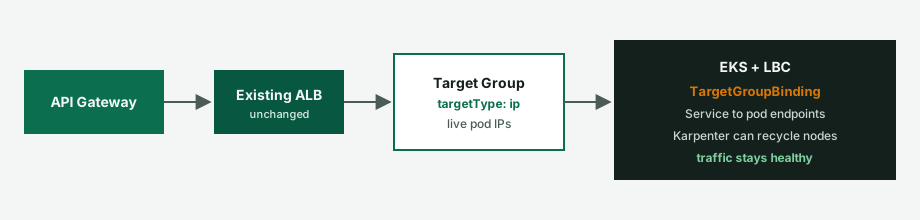
Before vs after
| Initial situation | After the change |
|---|---|
| Traffic loss when nodes rotated | Dynamic endpoint registration via LBC |
| Tickets on every deploy / scale | Stable deploys without hand-editing TGs |
| Manual Target Group upkeep | Pod IP targeting (targetType: ip) |
| Freeze from downtime fear | Transparent production change |
| Same fragile pattern copied across accounts | Repeatable chart/TGB pattern per cluster |
What this teaches (and what stays open)
- Autoscaling is not a networking free lunch. If the data path assumes node IPs, Karpenter will “break” something that was already fragile.
TargetGroupBindingis an excellent bridge when you cannot redesign API Gateway + ALB in one window.- Common next step: move EKS nodes from public to private subnets—after targets no longer depend on node IPs.
If you are in this mess (EKS + legacy ALB + Karpenter), order matters: stabilize the TG first, standardize Helm second, private subnets once traffic no longer depends on node IPs.